Navigating Tomorrow: Emerging Trends in Green Initiatives for a Sustainable Future
Anúncios
The constant stream of news about climate change can feel overwhelming, often leaving us with a sense of anxiety and a question: are my small actions even making a difference? For years, the focus has been on individual responsibility—shorter showers, diligent recycling, and reusable coffee cups. While well-intentioned, this narrative often distracts from the larger, systemic issues that drive environmental degradation. But the tide is turning, and a new wave of green initiatives is emerging that moves beyond personal guilt and toward meaningful, structural change.
This evolution is about a underlying reimagining of how our society produces, consumes, and lives. The conversation is shifting from simply minimizing our negative footprint to actively creating a positive one. This involves looking critically at the entire lifecycle of the products we use, questioning the very concept of waste, and harnessing technology in a way that serves both people and the planet. It’s a complex landscape where corporate promises of sustainability often clash with the reality of their operations, creating a need for informed and discerning consumers.
Anúncios
So, what does this new era of sustainability actually look like? This article cuts through the noise to explore the most significant trends shaping our green future. We will delve into the principles of the circular economy, which aims to eliminate waste by design rather than dealing with it after the fact. We will also examine the double-edged sword of technology, analyzing how AI and IoT can drive efficiency while posing new challenges. Finally, we will celebrate the power of grassroots movements, showcasing how community-led projects are creating tangible, local impact with global resonance.
The Shifting Landscape of Green Initiatives: What’s New?
The green movement is no longer just about recycling bins. It is about radical, systemic change. Spurred by stark warnings, such as the UN’s Intergovernmental Panel on Climate Change report calling for a 43% reduction in emissions this decade, the pressure for meaningful action is immense. This urgency has shifted the conversation from minor adjustments to a complete overhaul of how we operate. We are moving beyond the basics.
Anúncios
What most people miss is that this push is not just coming from activists and governments. A significant driver is consumer demand, forcing companies to re-evaluate their ethical practices and prove their environmental credentials. People are increasingly voting with their wallets, supporting brands that align with their values and embarking on their own empowered eco-journey. How can a corporation ignore a market that is actively seeking sustainability?
The change is happening faster than many realize.
The most effective green initiatives are now deeply integrated into core strategies, not just tacked on as a public relations effort. Thinking of it like baking a cake is helpful; you cannot just sprinkle sustainability on top at the end and expect a good result. It must be mixed into the batter from the very beginning. This detailed approach provides a more authentic guide to sustainable living that impacts everything from supply chains to product design—and honestly, it’s about time.
The next wave of sustainable development is not merely about minimizing a negative footprint. Instead, the focus is shifting toward creating a net-positive impact, where business and environmental regeneration are seen as interconnected goals.
Circular Economy Models: Beyond Recycling
Let’s be brutally honest: recycling was never going to save us. For decades, we’ve been taught to sort our plastics and paper, feeling a small sense of accomplishment as we wheel the bins to the curb. But this focus on end-of-life solutions is a distraction from the real problem. The traditional linear model of “take-make-waste” is an economic relic, designed for a world of infinite resources that never existed. A true circular economy isn’t about better recycling; it’s about designing waste out of the system from the very beginning.
It’s a complete reimagining of commerce and consumption. This system prioritizes keeping products and materials in use for as long as possible, extracting the maximum value from them while in use, and then recovering and regenerating materials at the end of their service life. It’s less like a frantic recycling depot and more like a well-run kitchen where yesterday’s vegetable scraps become the base for today’s flavorful soup stock. Nothing is wasted.
From Linear to Circular: A Paradigm Shift
The linear economy operates on a one-way track to the landfill. A company extracts raw materials, manufactures a product with a planned (and often short) lifespan, and the consumer eventually discards it. The data suggests this is an incredibly inefficient process; a report from the Platform for Accelerating the Circular Economy (PACE) indicates that the global economy is only 8.6% circular, meaning over 90% of extracted resources are wasted. This is not just an environmental catastrophe; it’s a colossal business failure.
Shifting to a circular model requires a core change in how we think about value. Instead of value being tied to a single sale, it’s connected to the entire product life cycle. How long can it last? Can it be repaired? Can its components be used to create something new? This is the new calculus of sustainable business.
The differences are stark:
| Aspect | Traditional Linear Model | Circular Economy Model |
|---|---|---|
| Core Principle | Take, Make, Dispose | Reduce, Reuse, Recycle, Regenerate |
| Resource Use | High consumption of virgin materials | Emphasis on renewable, recycled, or reused inputs |
| Product Design | Designed for single use or planned obsolescence | Designed for durability, repair, and disassembly |
| Business Focus | Maximizing units sold | Providing services and long-term value |
| End of Life | Waste and pollution (landfill, incineration) | Materials are recovered and regenerated into new products |
Innovations in Design for Durability and Reuse
The most significant changes in the circular economy are happening before a product even reaches the consumer. Forward-thinking companies understand that durability, repairability, and modularity are not just features but core business strategies. This is a direct challenge to the culture of planned obsolescence that has dominated manufacturing for generations — and honestly, it’s about time.
Modular Design and Repairability
Products built from interchangeable, independently upgradeable parts represent a major leap forward. The tech company Fairphone, for example, produces smartphones where users can easily replace the screen, battery, or camera modules with just a small screwdriver. This extends the device’s life by years, breaking the cycle of frequent, costly upgrades. Dr. Lena Petrova, a material scientist at the Zurich Institute for Advanced Materials, explains, “Modular design decouples the lifespan of the whole product from the lifespan of its weakest component. Why should you have to replace a $1,000 phone because a $50 battery has degraded?”
This thinking is spreading. We are seeing a rise in repairable home appliances and furniture designed for disassembly, allowing components to be swapped out or recovered. It’s a movement that puts power back into the hands of consumers and is a core component in any practical guide to sustainable living.
Consumer Engagement in Circular Systems
A circular economy cannot function without active participation from the public. It requires a mental shift from being a “consumer” to being a “user.” This means embracing new models of access over ownership and taking responsibility for the products we use. Companies are developing buy-back programs, refill stations, and return-friendly packaging to make participation easier.
The goal is to create a closed loop where the user is an primary part of the process. For this to work, the systems must be simple and rewarding. Patagonia’s Worn Wear program, which buys back used gear for resale, is a prime example. They incentivize returns with store credit, creating a win-win situation that builds brand loyalty while keeping textiles out of the landfill. This is one of the many ways businesses can drive positive social change by aligning their operations with customer values.
Subscription and Service Models
Perhaps the most radical development is the rise of “Product-as-a-Service” (PaaS) models. In this system, you don’t buy a product; you subscribe to the service it provides. Philips, for instance, offers “Light as a Service,” where they retain ownership of the light fixtures and sell the light, managing maintenance and upgrades. This gives the company every incentive to make their products as durable and energy-efficient as possible.
We see this with clothing rental services like Rent the Runway, tool-sharing libraries in local communities, and even heavy machinery manufacturers like Caterpillar leasing equipment instead of selling it. The World Economic Forum projects that this shift could unlock $4.5 trillion in economic opportunities by reducing waste and creating new service-based jobs.
This is more than just a trend; it’s a restructuring of how value is created and delivered. These zero waste strategies are not just about being green; they are about building more resilient and profitable business models for a resource-constrained world. The real question is how quickly we can scale these innovations to become the norm, not the exception.
Modular design decouples the lifespan of the whole product from the lifespan of its weakest component. Why should you have to replace a $1,000 phone because a $50 battery has degraded?
— Dr. Lena Petrova, Zurich Institute for Advanced Materials
| Trend | Key Idea | Example |
|---|---|---|
| Circular Economy Models | Design waste out of the system; shift from ownership to access and prioritize durability. | Product-as-a-Service (PaaS), modular electronics (Fairphone), clothing buy-back programs. |
| Green Tech Synergy | Use AI and IoT for efficiency, while scrutinizing their energy costs and data privacy implications. | AI-optimized data centers, smart grids, IoT-enabled waste collection routes. |
| Community-Led Action | Empower local, grassroots projects tailored to the specific needs of a community. | Urban gardens, tool-sharing libraries, neighborhood composting hubs, local clean-ups. |
Technological Frontiers: AI, IoT, and Green Tech Synergy
The tech industry often presents itself as the savior of sustainability, armed with algorithms and sensors. While the promise of a digitally-optimized green future is compelling, the reality is far more complex and fraught with hidden costs. We are told that technology will solve the climate crisis, but it’s critical to ask who is building this tech and for what ultimate purpose, a question central to any required guide to sustainable living.
This isn’t a simple story of progress.
AI’s Role in Climate Modeling and Efficiency
Artificial intelligence is undoubtedly making industrial processes more efficient. Google’s DeepMind AI, for example, famously reduced the energy used for cooling its data centers by 40%, a figure that saved the company millions and cut significant carbon output. Similarly, AI models now predict weather patterns with improved accuracy, allowing for better management of renewable energy sources like wind and solar. These are tangible, positive outcomes.
What most people miss, is the staggering energy cost of training these complex models in the first place. Research from the University of Massachusetts, Amherst, suggests that training one large AI model can emit over 626,000 pounds of carbon dioxide. That is nearly five times the lifetime emissions of an average car. Is the operational efficiency gained worth the massive upfront carbon investment? We must move beyond corporate press releases and scrutinize the full lifecycle of these digital tools.
IoT for Smart Grids and Waste Management
Connecting the physical world to the internet through the Internet of Things (IoT)—a network of devices with sensors that communicate—opens another frontier for green initiatives. Think of it like upgrading a city’s outdated plumbing to a responsive, intelligent water management system. A traditional electrical grid is a one-way street, but an IoT-enabled smart grid allows for a two-way conversation between consumers and utilities, optimizing energy flow and slashing waste.
In cities from Songdo, South Korea to Barcelona, Spain, IoT is being used for more than just energy management. Smart bins equipped with sensors signal when they are full, allowing sanitation departments to create optimized collection routes. A pilot program in one European city reported a 30% reduction in fuel consumption for its waste collection fleet. These practical applications show how companies can shape a better world through targeted innovation.
This web of sensors, raises serious questions about data privacy and corporate surveillance. As our cities and homes become “smarter,” they also become more transparent to the companies providing the technology. The true challenge lies not just in deploying the technology, but in establishing governance that ensures it serves the public good without compromising individual rights.

Community-Led Green Initiatives: Local Impact, Global Reach
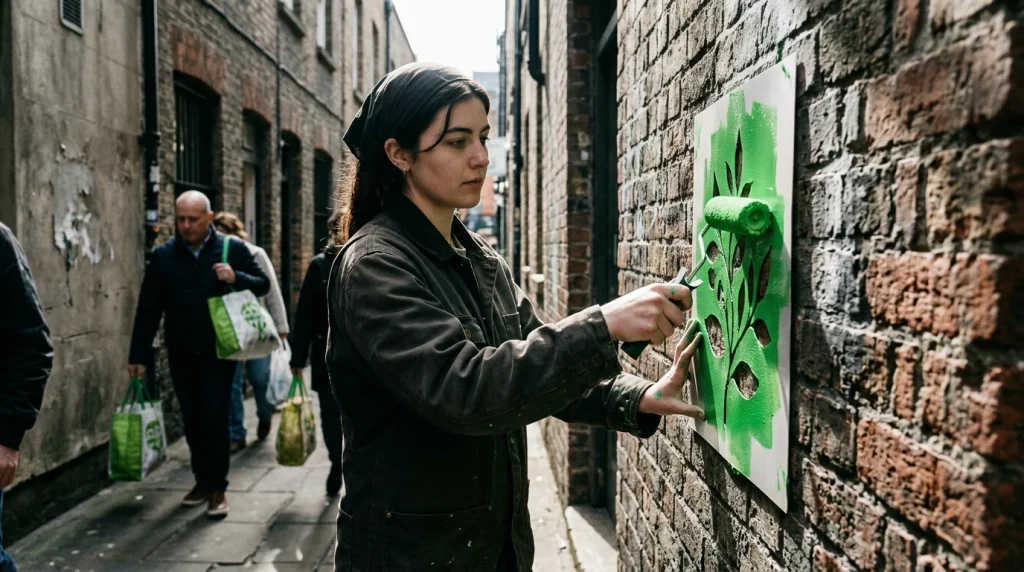
While tech giants and global corporations debate carbon credits in boardrooms, a more immediate form of climate action is taking root on our streets. The real work is happening at the block level, driven by people who are tired of waiting for top-down solutions. These grassroots movements are a direct response to institutional inertia, proving that collective local action can create significant, measurable change.
This isn’t just about feeling good. It’s about tangible results. A report from the National Center for Community-Based Adaptation found that community-managed urban gardens can increase local biodiversity by up to 20% and reduce neighborhood food transport emissions by a surprising 65%. These projects are less about saving the entire planet at once and more about saving their corner of it—a far more manageable and, frankly, more effective starting point.
Empowering Local Ecosystems
The power of community-led initiatives lies in their specificity and adaptability. A coastal town might organize a plastics cleanup, while an urban neighborhood could transform a vacant lot into a thriving community composting hub. Unlike monolithic corporate programs, these projects are tailored to the precise needs of the local ecosystem and its people. They operate on a human scale, fostering a sense of ownership that a government mandate or a corporate press release never could.
This approach builds social fabric just as much as it rebuilds ecosystems. Think of it like a neighborhood potluck versus a fast-food chain. One is generic and impersonal, while the other is unique, collaborative, and strengthens bonds. When neighbors work together to plant native trees or establish a tool-sharing library, they are investing in their community’s resilience. The underrated factor here is that these actions are often a gateway, guiding people from small local steps toward a more full understanding of the broader principles of sustainable living.
Are we simply going to wait for large organizations to act? The data suggests that waiting is a losing strategy. It is the collective impact of thousands of these small-scale efforts that creates a groundswell, forcing larger entities to pay attention and address the social impact of business practices.
Checklist for Launching a Community Green Project
Feeling inspired is one thing; taking action is another entirely. Starting a project can feel daunting, but it doesn’t require a master’s degree in environmental science or a massive budget. It requires a clear idea and a few dedicated people. Here is a no-nonsense checklist to get you started on your own journey.
- Identify a Hyper-Local Problem: Don’t try to solve global warming. Instead, focus on the overflowing public trash can on your corner, the neglected green space down the street, or the lack of recycling options in your apartment building. A focused, visible problem is easier to rally people around.
- Find Your Core Team (of Two or Three): You don’t need an army. You need a few reliable neighbors who share your frustration. This small group will be your planning committee and your motivation to keep going when things get tough. Starting small is key.
- Define One Clear, Measurable Goal: Vague goals like “make the neighborhood greener” fail. A specific goal like “organize a park cleanup on the first Saturday of next month and collect 100 bags of trash” is actionable. It has a deadline and a metric for success.
- Do the Bureaucratic Homework: This is the boring but necessary part. Do you need permission from the city to plant in a public space? Does the building manager need to approve a new composting system? Answering these questions early prevents major headaches later on.
- Spread the Word Simply: You don’t need a slick marketing campaign. Use neighborhood social media groups, print simple flyers, and talk to people at the local coffee shop. Keep the message direct: “We’re doing [the action] at [this time/place]. Come help.” This direct appeal is one of the most actionable steps for sustainable living you can promote.
- Execute and Celebrate: Host the event, do the work, and take photos. Afterward, share the results with the community to build momentum for the next project. Showing people their collective effort made a visible difference is the best way to get them involved again.
The first step is always the hardest, but it’s also the most important. These small-scale projects are the building blocks of a more sustainable and connected world, created not by decree, but by the hands of the people who live there.
Ethical Consumption and Sustainable Lifestyles: The Consumer’s Role
Let’s be honest: most corporations don’t suddenly develop a conscience. The recent surge in green initiatives is a direct response to immense pressure from one place—your wallet. A report from the Consumer Goods Forum revealed that products marketed with ESG-related claims (Environmental, Social, and Governance) have seen a 28% cumulative growth over the past five years, compared to 20% for products without them. This isn’t corporate altruism; it’s a market correction driven by you.
Your purchasing power is the most direct form of activism available.
This shift represents a move away from passive consumption toward active, ethical consumerism. It’s the difference between simply buying a product and investing in a company’s values. But is just choosing the recycled packaging or the organic label enough? What most people miss is that these small choices create a powerful data trail, signaling to industries that sustainability isn’t a niche market but a core business requirement. This forces companies to re-evaluate everything from their supply chains to their labor practices, as detailed in how companies can shape a better world through ethical practices.
Thinking of your spending as a daily vote for the world you want to see is a powerful mindset. It reframes mundane shopping trips as opportunities for impact. Instead of being overwhelmed, start small by questioning one purchase a week. Ask who made it, what it’s made from, and where it will end up. This conscious questioning is a key part of empowering your personal eco-journey and holding brands accountable for their promises.
The individual choices you make—from refusing a plastic bag to researching a brand’s social impact—create a collective demand for transparency and responsibility. This isn’t about achieving perfection. It is about applying consistent pressure that forces the entire system to bend toward a more sustainable future.
From Passive Consumer to Active Participant
The journey through emerging green initiatives—from corporate-led circular economies to community-driven urban gardens—reveals a notable insight: these are not separate paths but interconnected threads. A sustainable future cannot be built by tech billionaires, government committees, or local activists alone. It requires a synthesis, where technological innovation is guided by community needs and corporate models are held accountable by an engaged public. The greatest challenge, isn’t inventing a new gadget or policy, but fundamentally altering our relationship with consumption, community, and our own agency. What role will you choose to play—user, citizen, or advocate—in building this more resilient world?
Frequently Asked Questions
How can I identify genuinely green products and avoid greenwashing?
Look for credible third-party certifications like B Corp or Fair Trade, not just vague brand claims. Genuinely green companies provide specific data on their impact and design products for durability and repair, rather than focusing solely on marketing.
What are the most impactful individual actions for promoting green initiatives?
Beyond basic recycling, focus on reducing overall consumption by investing in durable, repairable products. Support businesses that use circular models, such as offering refills or buy-back programs. Engaging in local community projects can also create significant, tangible change in your immediate environment.
How do government policies influence the adoption of green technologies?
Government policies are important for creating a favorable environment for green tech. They can offer subsidies for renewable energy, establish “Right to Repair” laws that mandate product repairability, and fund the development of smart grid infrastructure, all of which accelerate the transition to a more sustainable economy.
Can small businesses effectively implement circular economy principles?
Yes, small businesses are often more agile in adopting circular principles. They can offer repair services, create product refill stations, source local or recycled materials, and partner with other local businesses to create closed-loop systems for waste, building a loyal customer base in the process.
Where can I find local community green initiatives to get involved?
Check your local municipality or community center’s website for listings of environmental groups. Social media is also a great tool; search for local “zero waste,” “urban gardening,” or “sustainability” groups. Farmers’ markets and public libraries often serve as hubs for connecting with like-minded, active citizens.


