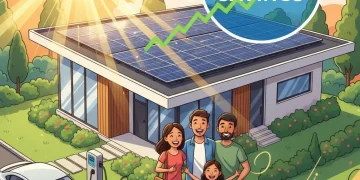
Claim Your 2026 Renewable Energy Tax Credits: Up to $2,000 for Home Improvements

Anúncios
Are you looking to make your home more energy-efficient and save money on your taxes? The year 2026 brings exciting opportunities for homeowners to invest in sustainable solutions while benefiting from generous tax credits. Understanding the intricacies of the renewable energy credits 2026 can help you claim up to $2,000 for eligible home improvements, making your eco-friendly upgrades even more appealing.
In an era where sustainability is paramount, governments are increasingly incentivizing individuals to adopt greener practices. The U.S. federal government, through various acts like the Inflation Reduction Act (IRA), has extended and enhanced tax credits for homeowners who invest in renewable energy and energy-efficient home improvements. These credits are not just about saving money; they’re about contributing to a healthier planet and increasing your home’s value and comfort.
Anúncios
This comprehensive guide will walk you through everything you need to know about the renewable energy credits 2026. We’ll explore what qualifies, how much you can save, the steps to claim these credits, and strategic planning tips to maximize your benefits. Whether you’re considering solar panels, a new heat pump, or better insulation, this information is crucial for making informed decisions.
Anúncios
Understanding the Landscape of Renewable Energy Tax Credits in 2026
The landscape of tax credits for renewable energy has been significantly bolstered in recent years, with provisions set to continue providing substantial benefits through 2026 and beyond. These incentives are designed to accelerate the adoption of clean energy technologies and reduce household carbon footprints.
What Are Renewable Energy Tax Credits?
Renewable energy tax credits are non-refundable tax credits that reduce the amount of income tax you owe. If the credit amount exceeds your tax liability, you won’t receive the excess as a refund, but in some cases, you might be able to carry forward unused credits to future tax years. For 2026, the primary credit for homeowners is often referred to as the Energy Efficient Home Improvement Credit (Section 25C) and the Residential Clean Energy Credit (Section 25D).
Key Changes and Continuations for 2026
The Inflation Reduction Act (IRA) of 2022 made significant updates to these credits, extending them and, in some cases, increasing the credit amounts and eligible expenses. For 2026, many of these enhanced benefits remain in effect, offering a stable and predictable incentive for homeowners. It’s important to note that while some credits are annual, others have lifetime limits, or limits per installation. We’ll delve into these specifics shortly.
Why These Credits Matter for Homeowners
Investing in renewable energy and energy efficiency can be a significant upfront cost. Tax credits help offset these expenses, making these upgrades more financially accessible. Beyond the immediate tax savings, these improvements lead to lower utility bills, increased home comfort, and a higher property value. Furthermore, by embracing renewable energy, you’re playing a direct role in combating climate change and fostering energy independence.
Eligible Home Improvements for Renewable Energy Credits 2026
To claim the renewable energy credits 2026, your home improvements must meet specific criteria. The IRS categorizes eligible expenses under different sections, primarily focusing on clean energy generation and energy-efficient home upgrades.
Residential Clean Energy Credit (Section 25D)
This credit is one of the most generous and covers a substantial portion of the cost for certain renewable energy systems installed in your home. For installations through 2032, this credit is generally 30% of the cost of new, qualified clean energy property for your home. There is no credit limit for most of these technologies, except for fuel cell property.
- Solar Electric Property (Solar Panels): This includes equipment that uses solar energy to generate electricity for your home. This is arguably the most popular and impactful renewable energy upgrade. The 30% credit applies to the cost of the solar panels, installation, and associated equipment.
- Solar Water Heating Property: Systems that use solar energy to heat water for use in your dwelling. At least half of the energy generated by the solar water heater must be derived from the sun.
- Wind Energy Property: Small wind turbines that generate electricity for your home.
- Geothermal Heat Pump Property: Systems that use the earth’s natural heat to warm and cool your home. These are highly efficient and can significantly reduce energy consumption.
- Fuel Cell Property: Fuel cell power plants that use an electrochemical process to generate electricity. There’s a $500 credit limit for each 0.5 kilowatt (kW) of capacity.
- Battery Storage Technology: For systems installed after December 31, 2022, battery storage technology with a capacity of at least 3 kilowatt hours (kWh) also qualifies for the 30% credit. This is excellent for maximizing the benefits of solar panels by storing excess energy.
It’s important that these systems are new and installed on an existing home or a newly constructed home that will serve as your principal residence. The credit also covers labor costs for onsite preparation, assembly, or installation of the property.
Energy Efficient Home Improvement Credit (Section 25C)
This credit focuses on improving the energy efficiency of your home. Unlike the 25D credit, which covers a percentage of the total cost with no cap for most items, the 25C credit has annual limits. For 2026, the annual limit is up to $1,200 for most energy-efficient home improvements, with specific higher limits for certain items.
- Energy Audits: Up to $150 credit for a home energy audit conducted by a qualified energy auditor. This is a great starting point to identify the most impactful upgrades.
- Exterior Doors: Up to $250 credit per door, with an annual limit of $500. Must meet ENERGY STAR requirements.
- Exterior Windows and Skylights: Up to $600 credit. Must meet ENERGY STAR requirements.
- Insulation and Air Sealing Materials: Up to $1,200 credit. This includes items like fiberglass, cellulose, spray foam, weather stripping, and caulk.
- Home Energy Property Costs: A credit of 30% of the cost, up to $600 per item, for qualified energy property such as:
- Central air conditioners (meeting CEE Tier 2 or higher)
- Natural gas, propane, or oil furnaces or hot water boilers (meeting >90% AFUE)
- Electric or natural gas heat pumps
- Electric or natural gas heat pump water heaters
- Biomass stoves and boilers
The combined total for all items under Section 25C (excluding heat pumps, biomass stoves/boilers, and home energy audits) is capped at $1,200 per year. However, there’s a separate annual limit of $2,000 for qualified heat pumps, biomass stoves, and boilers. This means you could potentially claim $1,200 for windows/insulation and an additional $2,000 for a heat pump, totaling $3,200 in 25C credits in a single year, though the article title focuses on the $2,000 for home improvements more broadly, including the combination of elements that can lead to this figure. The main point is that the renewable energy credits 2026 offer significant potential.

Navigating the $2,000 Cap and Maximizing Your Savings
While some sections, like the Residential Clean Energy Credit (25D) for solar panels, have no upper limit on the credit amount (other than the 30% of cost), the Energy Efficient Home Improvement Credit (25C) has annual and per-item limits. The $2,000 figure often cited, including in this article’s title, refers to the maximum annual credit you can claim for specific energy-efficient improvements under Section 25C, particularly when combining certain categories like heat pumps with other upgrades. It’s crucial to understand how these caps work to effectively plan your projects and maximize your renewable energy credits 2026.
Annual Limits vs. Per-Item Limits
For Section 25C, the general annual limit for most energy efficiency improvements (windows, doors, insulation, etc.) is $1,200. However, there’s a specific separate annual limit of $2,000 for qualified heat pumps, biomass stoves, and biomass boilers. This means if you install a qualifying heat pump, you could claim up to $2,000 for that alone. If you also replace windows and add insulation, you could claim an additional $1,200 for those items, bringing your potential total to $3,200 in a single year from 25C. The phrasing of getting ‘up to $2,000 for home improvements’ in the title often refers to this significant component or a strategic combination of projects.
Strategic Planning for Multi-Year Projects
Since the Section 25C credit is an annual limit, if you have extensive renovations planned, it might be beneficial to spread them across multiple tax years. For example, if you plan to replace all your windows and install a new heat pump, and the total eligible costs for the windows would exceed the $1,200 annual cap, you could install some windows in one year and the rest in the next, along with the heat pump, to maximize your credit over time. This requires careful planning and understanding of the specific annual limits for each category of improvement. The renewable energy credits 2026 are designed to encourage ongoing investment in energy efficiency.
How to Claim Your Renewable Energy Tax Credits in 2026
Claiming your renewable energy credits 2026 isn’t overly complicated, but it requires diligent record-keeping and understanding the correct IRS forms.
Step-by-Step Guide to Claiming
- Identify Eligible Improvements: First, ensure the improvements you’ve made or plan to make qualify for the credits. Refer to the IRS guidelines and the information above.
- Keep Detailed Records: Maintain meticulous records of all expenses related to your qualified home improvements. This includes invoices, receipts, proof of payment, and manufacturer’s certifications that the equipment meets efficiency standards. These documents are crucial in case of an IRS audit.
- Complete IRS Form 5695: To claim the Residential Clean Energy Credit (Section 25D) and the Energy Efficient Home Improvement Credit (Section 25C), you will need to file IRS Form 5695, Residential Energy Credits, with your tax return.
- Calculate Your Credit: Follow the instructions on Form 5695 to calculate the exact amount of credit you are eligible for. The form will guide you through the various limits and calculations for different types of improvements.
- File Your Tax Return: Attach Form 5695 to your Form 1040 (U.S. Individual Income Tax Return) when you file your taxes.
Important Documentation
Beyond receipts, some manufacturers provide a "Manufacturer’s Certification Statement" that confirms their product qualifies for the energy efficient home improvement tax credit. While you don’t typically submit this form with your tax return, you should keep it for your records. For solar, wind, and geothermal systems, documentation should include the date of installation, the cost of materials and labor, and proof that the equipment meets necessary performance and safety standards.
Beyond Federal Credits: State and Local Incentives
While the federal renewable energy credits 2026 offer substantial savings, don’t overlook potential state and local incentives. Many states, counties, and even utility companies offer their own rebates, tax credits, or low-interest loan programs for energy-efficient upgrades.
Researching Local Programs
A great resource for finding local incentives is the Database of State Incentives for Renewables & Efficiency (DSIRE). This comprehensive database allows you to search by state and technology to find programs that can be stacked with federal credits, further reducing your out-of-pocket expenses. Combining federal, state, and local incentives can significantly enhance the financial viability of your projects.
Utility Company Rebates
Many utility companies offer rebates for installing energy-efficient appliances, smart thermostats, or even for conducting home energy audits. Check your local utility provider’s website or contact their customer service to inquire about available programs. These rebates can often be claimed in addition to federal tax credits.

Common Questions and Expert Tips
As you plan your energy-efficient home improvements, a few common questions often arise. Here are some answers and expert tips to help you navigate the process smoothly and maximize your renewable energy credits 2026.
Can I claim these credits if I rent my home?
Generally, these federal tax credits are for homeowners who install qualifying improvements on their primary or secondary residence. Renters typically cannot claim these specific credits, as they do not own the property. However, renters might be eligible for other energy-related programs or rebates offered by local utilities or state governments, so it’s always worth checking.
What if I’m building a new home?
The Residential Clean Energy Credit (Section 25D) generally applies to both existing homes and new constructions that serve as your principal residence. The Energy Efficient Home Improvement Credit (Section 25C) primarily applies to improvements made to an existing home that is your principal residence. If you are building a new home, ensure your builder can provide documentation for qualifying energy-efficient components.
Are there income limitations for these credits?
No, generally there are no income limitations to claim the federal residential energy tax credits for individuals. This makes them accessible to a wide range of homeowners. However, some state or local programs might have income-based eligibility requirements. Always check the specific program details.
What if the credit is more than I owe in taxes?
Both the Residential Clean Energy Credit (25D) and the Energy Efficient Home Improvement Credit (25C) are non-refundable. This means they can reduce your tax liability to $0, but you won’t get any excess credit back as a refund. However, for the Residential Clean Energy Credit (25D), any unused portion of the credit can be carried forward to future tax years, allowing you to use the full benefit eventually. The Energy Efficient Home Improvement Credit (25C) is an annual credit and generally does not carry forward.
Expert Tip: Consult a Tax Professional
While this guide provides comprehensive information, tax laws can be complex and are subject to change. It is always highly recommended to consult with a qualified tax professional or financial advisor before making significant investment decisions based on tax credits. They can provide personalized advice based on your specific financial situation and ensure you accurately claim all eligible renewable energy credits 2026.
The Long-Term Benefits of Energy-Efficient Homes
Beyond the immediate financial incentives of the renewable energy credits 2026, investing in energy-efficient home improvements offers a plethora of long-term advantages that extend far beyond tax season.
Reduced Utility Bills
This is perhaps the most obvious and immediate long-term benefit. By installing solar panels, upgrading to a high-efficiency heat pump, improving insulation, or replacing old windows, you significantly reduce your reliance on traditional energy sources and minimize energy waste. This translates directly into lower monthly electricity, heating, and cooling bills, providing continuous savings for years to come. Over the lifespan of these systems, the cumulative savings can be substantial, often outweighing the initial investment.
Increased Home Value
Energy-efficient homes are increasingly attractive to potential buyers. Features like smart thermostats, and superior insulation are seen as valuable assets that lower operating costs and contribute to a modern, sustainable lifestyle. Studies consistently show that homes with renewable energy systems and high energy efficiency ratings command higher resale values and sell faster than comparable properties lacking these features. Investing in these upgrades is not just an expense; it’s an enhancement to your property’s market appeal and intrinsic worth.
Enhanced Comfort and Indoor Air Quality
Improved insulation, air sealing, and high-performance windows not only keep energy costs down but also create a more comfortable indoor environment. They help maintain consistent temperatures throughout your home, eliminate drafts, and reduce outside noise. Furthermore, modern HVAC systems, including heat pumps, often come with advanced filtration systems that improve indoor air quality, reducing allergens and pollutants and contributing to a healthier living space.
Environmental Impact and Sustainability
By harnessing solar, wind, or geothermal energy, or by simply reducing your overall energy consumption, you significantly decrease your home’s carbon footprint. This directly contributes to the fight against climate change by reducing greenhouse gas emissions and lessening reliance on fossil fuels. Embracing renewable energy makes your home a part of the solution for a more sustainable future, aligning your personal actions with global environmental goals.
Energy Independence and Resilience
Generating your own electricity with solar panels, especially when paired with battery storage, can provide a degree of energy independence. This means less vulnerability to rising energy prices and greater resilience during power outages. In an increasingly unpredictable world, having a reliable, self-sufficient energy source for your home offers peace of mind and security.
Technological Advancement and Innovation
The renewable energy sector is constantly evolving, with new technologies and efficiencies emerging regularly. By investing in these systems, you are participating in and supporting this innovation. Many modern energy solutions come with smart home integration, allowing for greater control and monitoring of your energy consumption, further optimizing performance and savings.
Preparing for Your 2026 Renewable Energy Upgrades
To successfully leverage the renewable energy credits 2026, preparation is key. Here’s a checklist to help you get started:
- Assess Your Home’s Needs: Consider a professional home energy audit to identify the most impactful upgrades for your specific home. This can help prioritize investments.
- Research Qualified Products and Contractors: Ensure any products you purchase are certified to meet efficiency standards (e.g., ENERGY STAR compliant). Choose reputable contractors with experience in installing renewable energy systems and energy-efficient upgrades. Ask for references and verify their credentials.
- Obtain Multiple Quotes: Get quotes from several contractors to compare costs, services, and timelines. This also helps you understand the market value of the improvements.
- Understand the Specifics: Familiarize yourself with the detailed requirements for each credit you plan to claim. The IRS website (IRS.gov) is your authoritative source for the latest information on Form 5695 and related publications.
- Budget Accordingly: While tax credits offer significant savings, there will still be an upfront cost. Plan your finances carefully and explore financing options if needed.
- Stay Informed: Tax laws can change. Keep an eye on IRS updates or consult your tax professional annually to ensure you’re aware of any new developments that might affect your eligibility or credit amounts.
Conclusion: Embrace a Sustainable and Economical Future
The opportunity to claim significant renewable energy credits 2026 for home improvements presents a compelling reason to invest in your home’s energy efficiency and clean energy generation. With potential savings of up to $2,000 (and even more when combining various credits), these incentives make sustainable living more accessible and financially rewarding.
By taking advantage of these credits, you’re not just reducing your tax burden; you’re also embarking on a journey towards lower utility bills, increased home comfort and value, and a reduced environmental footprint. The long-term benefits far outweigh the initial investment, creating a win-win situation for your wallet and the planet.
Start planning your energy-efficient upgrades today. Research eligible improvements, gather your documentation, and consult with professionals to ensure you maximize every available credit. Your home, your finances, and the environment will thank you for embracing the power of renewable energy credits 2026.