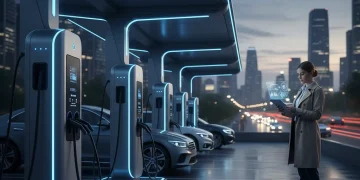
EV Charging Infrastructure: Powering U.S. Green Grids by 2030

Anúncios
The United States is on the precipice of a monumental energy transformation, driven by an accelerating shift towards electric vehicles (EVs). This paradigm shift, while promising a cleaner future, brings with it a complex challenge: how to seamlessly integrate a burgeoning EV charging infrastructure with the existing, and increasingly green, national power grid. The year 2030 stands as a critical benchmark, by which time the impact of EV charging on U.S. green grids will be profound and multifaceted. Understanding this intricate relationship is paramount for policymakers, utility providers, automotive manufacturers, and consumers alike.
At its core, the transition to EVs is a move away from fossil fuels and towards electrification. This electrification, however, is only truly “green” if the electricity itself is generated from renewable sources. Therefore, the future of EV adoption is inextricably linked to the evolution of the U.S. green grid. This article delves into the critical aspects of this integration, exploring the challenges, opportunities, technological advancements, and policy frameworks that will shape the landscape of EV charging and its impact on the nation’s sustainable energy future.
Anúncios
The Current State of EV Adoption and Charging Infrastructure
The growth of electric vehicles in the U.S. has been exponential. Sales continue to climb, driven by a combination of environmental consciousness, government incentives, and advancements in battery technology that offer increased range and performance. As of early 2020s, millions of EVs are already on American roads, and projections for 2030 suggest this number will multiply several times over. This rapid uptake necessitates a robust and widespread charging infrastructure to support daily commuting, long-distance travel, and commercial fleet operations.
Currently, the charging landscape is a mix of residential Level 1 and Level 2 chargers, public Level 2 chargers, and a growing network of DC fast chargers. While the number of charging stations is increasing, their distribution, reliability, and capacity are still areas of significant development. Many existing charging points are concentrated in urban centers, leaving rural areas underserved. The reliability of public chargers has also been a recurring concern for EV owners, highlighting the need for standardized maintenance and operational excellence.
Anúncios
The demand for electricity from this expanding EV fleet poses a significant challenge to the grid. A single EV charging at home adds a considerable load, comparable to several major household appliances operating simultaneously. When scaled to millions of vehicles, this demand could strain local distribution networks and, if not managed properly, impact the stability and reliability of the wider grid. This is where the concept of the “green grid” becomes crucial, as simply increasing electricity generation without focusing on renewable sources would negate the environmental benefits of EVs.
The U.S. green grid, characterized by an increasing share of renewable energy sources like solar, wind, and hydropower, aims to decarbonize the electricity sector. Integrating EV charging into this evolving grid requires careful planning and innovative solutions to ensure that the increased demand is met by clean energy, rather than triggering a reliance on fossil fuel “peaker plants” during peak charging times. The synergy between EV charging and green grid development is therefore a two-way street: EVs need a clean energy supply, and the grid can potentially benefit from EVs as flexible energy storage.
Challenges and Opportunities for Grid Integration
Integrating a massive increase in EV charging into the U.S. power grid presents several formidable challenges. The most immediate concern is the potential for increased peak demand. If a large number of EVs charge simultaneously, especially during existing peak electricity consumption hours (e.g., late afternoon and early evening), it could overwhelm grid capacity, leading to blackouts or brownouts. This necessitates significant upgrades to transmission and distribution infrastructure, which are costly and time-consuming.
Another challenge stems from the intermittent nature of renewable energy sources. Solar power is only available during the day, and wind power fluctuates with weather patterns. This variability makes balancing supply and demand more complex. If EV charging demand peaks when renewable generation is low, it could force the grid to rely on more carbon-intensive sources. This highlights the need for sophisticated grid management systems and energy storage solutions.
However, these challenges also unlock significant opportunities. EVs, with their large battery capacities, can actually become a vital component of the green grid. This concept is known as Vehicle-to-Grid (V2G) technology. V2G allows EVs to not only draw power from the grid but also to feed excess energy back into it when needed. This bidirectional flow of energy can help stabilize the grid by providing ancillary services such as frequency regulation, voltage support, and peak shaving. Imagine a scenario where thousands of parked EVs act as a distributed battery storage system, absorbing surplus renewable energy when available and discharging it during periods of high demand or low renewable output.
Furthermore, smart charging technologies offer another powerful opportunity. Instead of chaotic, unmanaged charging, smart charging systems can optimize charging times based on grid conditions, electricity prices, and renewable energy availability. This could involve charging EVs during off-peak hours when electricity is cheaper and often greener, or even pausing charging when the grid is under stress. Demand response programs, where consumers are incentivized to shift their charging patterns, will play a crucial role in managing the EV load.

Technological Innovations Driving the Integration
The successful integration of EV charging with green grids by 2030 hinges on continuous technological innovation. Several key areas are seeing rapid development:
Smart Charging and Demand Response
Smart charging solutions are evolving rapidly, moving beyond simple scheduling. Advanced algorithms consider real-time grid conditions, weather forecasts (for renewable generation predictions), and individual consumer preferences to optimize charging. This includes dynamic pricing models that incentivize off-peak charging and automated systems that can remotely manage charging sessions to prevent grid overload. Demand response programs are becoming more sophisticated, allowing utility companies to communicate directly with charging infrastructure and EV owners to adjust charging in response to grid needs.
Vehicle-to-Grid (V2G) and Vehicle-to-Home (V2H) Technologies
V2G technology is no longer a futuristic concept; it’s being piloted and deployed in various regions. This technology transforms EVs from mere consumers to active participants in the energy ecosystem. By allowing EVs to discharge power back to the grid, they can act as mobile energy storage units, absorbing excess renewable energy and deploying it when needed. Similarly, Vehicle-to-Home (V2H) technology enables EVs to power a household during outages, further enhancing energy resilience. The widespread adoption of V2G will require standardized communication protocols between vehicles, chargers, and the grid, as well as appropriate regulatory frameworks and market mechanisms to compensate EV owners for their contributions.
Advanced Battery Technology and Energy Storage
Improvements in EV battery technology are not just about increasing range; they also impact grid integration. Faster charging capabilities, longer battery lifespans, and improved energy density contribute to a more efficient and flexible energy storage system within the EV fleet. Beyond EVs, large-scale stationary battery storage systems, often co-located with renewable energy plants, are essential for buffering the intermittency of solar and wind power. These grid-scale batteries can store excess renewable energy and release it during peak demand, further stabilizing the grid and reducing reliance on fossil fuels.
Grid Modernization and Digitization (Smart Grid)
The concept of a “smart grid” is central to managing the complexities of EV integration. A smart grid utilizes digital communication technology to detect and react to local changes in usage, allowing for more efficient distribution of electricity. This includes smart meters that provide real-time consumption data, advanced sensors that monitor grid health, and sophisticated software that optimizes power flow. Artificial intelligence and machine learning are increasingly being employed to predict demand, manage renewable energy fluctuations, and prevent outages, making the grid more resilient and responsive to the dynamic needs of EV charging.
Policy and Regulatory Frameworks
Realizing the full potential of EV charging integration with green grids by 2030 requires robust and forward-thinking policy and regulatory frameworks. Governments at federal, state, and local levels play a crucial role in shaping this future.
Incentives and Subsidies
Continued and expanded incentives for EV purchases, charging infrastructure deployment, and renewable energy generation are vital. These can include tax credits, rebates, and grants for individuals, businesses, and municipalities. Policies that support the installation of Level 2 and DC fast chargers in underserved areas, workplaces, and multi-unit dwellings are particularly important to ensure equitable access to charging.
Standardization and Interoperability
A fragmented charging ecosystem can hinder EV adoption. Policies promoting standardization of charging connectors, communication protocols (like Open Charge Point Protocol – OCPP), and payment systems are essential for a seamless user experience. Interoperability between different charging networks and grid operators is also crucial for effective smart charging and V2G implementation.
Grid Modernization Investment
Significant government investment in grid modernization projects is necessary to upgrade aging infrastructure and build out the capabilities required for a smart, resilient, and green grid. This includes funding for advanced metering infrastructure, distribution automation, and utility-scale energy storage projects. Regulatory bodies must also create frameworks that allow utilities to recover these investments while ensuring fair rates for consumers.
V2G and Demand Response Market Mechanisms
To incentivize EV owners and aggregators to participate in V2G and demand response programs, clear market mechanisms and compensation structures need to be established. This involves developing tariffs that reward EV owners for providing grid services and creating markets where aggregated EV flexibility can be traded. Policymakers must also address potential issues around battery degradation and warranty concerns for V2G participants.
Building Codes and Permitting
Streamlining permitting processes for charging station installation and updating building codes to mandate EV-ready infrastructure in new constructions are critical steps. This proactive approach ensures that future buildings are equipped to handle the increased electrical load from EVs, reducing retrofit costs and accelerating deployment.
Regional Variations and Case Studies
The impact of EV charging on green grids will not be uniform across the U.S. Regional variations in renewable energy resources, existing grid infrastructure, population density, and EV adoption rates will lead to diverse challenges and solutions. For instance, states with abundant solar energy, like California, might focus on maximizing daytime charging and V2G to absorb excess solar. States with strong wind resources, such as Texas, might leverage EV charging to balance evening wind generation.
California’s Leadership
California has been at the forefront of EV adoption and green grid initiatives. The state has implemented ambitious mandates for EV sales and renewable energy targets. Its efforts include significant investments in charging infrastructure, pilot programs for V2G technology, and innovative demand response programs that integrate EVs. Lessons learned from California’s experience, including managing peak demand with high solar penetration, offer valuable insights for other regions.
Northeast and Mid-Atlantic Initiatives
Regions in the Northeast and Mid-Atlantic are also making strides, often focusing on regional collaboration to build out charging corridors and integrate offshore wind power. States like New York and Massachusetts are investing in smart grid technologies and exploring how EVs can support grid resilience in densely populated areas.
Midwest’s Emerging Role
The Midwest, with its growing renewable energy capacity (especially wind), presents unique opportunities. Developing charging infrastructure in more dispersed rural areas and integrating it with local renewable energy projects will be key. Agricultural communities could also see benefits from electric farm vehicles and associated charging infrastructure.

The Role of Consumers and Businesses
While technology and policy set the stage, the active participation of consumers and businesses is paramount for the successful integration of EV charging into green grids. Consumer behavior, influenced by convenience, cost, and awareness, will dictate charging patterns.
Educating Consumers
Public awareness campaigns are essential to educate EV owners about the benefits of smart charging, off-peak charging, and V2G opportunities. Understanding how their charging habits impact the grid and how they can save money and contribute to sustainability will encourage desired behaviors.
Business Adoption and Fleet Electrification
Businesses, particularly those with large vehicle fleets, represent a significant opportunity. Fleet electrification can be managed more efficiently, with centralized charging depots that can implement smart charging and V2G on a larger scale. Delivery services, public transport, and corporate fleets can become powerful assets for grid stability and renewable energy integration. Companies like Amazon and UPS, with their commitments to electrifying their delivery fleets, are already demonstrating this potential.
Workplace Charging
Providing workplace charging infrastructure can significantly shift charging demand away from residential peak hours. Employees can charge their vehicles during the workday, often when solar generation is high and residential demand is lower, thereby distributing the load more evenly throughout the day.
Looking Ahead to 2030 and Beyond
By 2030, the U.S. green grid will be significantly more resilient, intelligent, and interconnected than it is today. EV charging infrastructure will be a ubiquitous feature of the landscape, seamlessly integrated into homes, workplaces, and public spaces. The relationship between EVs and the grid will be symbiotic: EVs will draw clean energy, and in turn, they will provide valuable services to stabilize and optimize the grid.
We can expect to see a more mature V2G ecosystem, with standardized protocols and clear market incentives. Artificial intelligence will play an even greater role in optimizing energy flow, predicting demand fluctuations, and managing distributed energy resources. The focus will shift from simply meeting demand to actively shaping it for maximum efficiency and sustainability.
However, challenges will persist. Continued investment in grid upgrades, cybersecurity measures for smart grid systems, and ensuring equitable access to charging infrastructure for all communities will remain critical priorities. The rapid pace of technological change also means continuous adaptation and innovation will be necessary to stay ahead of evolving demands.
The journey towards a fully integrated EV charging and green grid system is complex, but the benefits – a cleaner environment, enhanced energy security, and a more resilient power system – are immense. The foundational work being done now, through policy, technology, and collaboration, will pave the way for a sustainable and electrified future for the United States.
Conclusion
The impact of EV charging infrastructure on U.S. green grids by 2030 will be transformative. It represents not just an increase in electricity demand but a fundamental shift in how we conceive of and manage our energy resources. The convergence of rapidly advancing EV technology, expanding renewable energy generation, and an increasingly intelligent grid presents an unprecedented opportunity to build a truly sustainable energy ecosystem. While significant hurdles remain in terms of infrastructure development, grid modernization, and policy harmonization, the innovative solutions emerging today – from smart charging to V2G – demonstrate a clear path forward. By strategically investing in infrastructure, fostering technological innovation, and implementing supportive policies, the U.S. can ensure that the rise of electric vehicles powers a greener, more resilient, and sustainable national grid for decades to come.