2026 Federal Solar Tax Credit: Maximize Your Home Savings Up to 30%

Anúncios
In an era where sustainability and economic prudence increasingly intersect, homeowners across the United States are turning their attention to solar energy. The allure is undeniable: reduced electricity bills, a smaller carbon footprint, and enhanced energy independence. However, for many, the initial investment in a solar energy system can seem daunting. This is where the federal solar tax credit, officially known as the Investment Tax Credit (ITC), steps in as a game-changer. For 2026, this powerful incentive continues to offer a substantial financial boost, allowing homeowners to save up to 30% on the cost of their solar installation. Understanding the nuances of this credit is paramount to maximizing your savings and making the transition to solar as financially advantageous as possible. This comprehensive guide will delve into everything you need to know about the 2026 federal solar tax credit, ensuring you are well-equipped to leverage this opportunity.
Anúncios
What is the Federal Solar Tax Credit?
The federal solar tax credit is a non-refundable tax credit for new residential and commercial solar energy systems. It allows you to deduct a percentage of the cost of installing a solar energy system from your federal income taxes. Enacted in 2006, the ITC has been instrumental in the growth of solar energy adoption across the nation. Its primary goal is to encourage investment in renewable energy technologies by making them more affordable for consumers. While the credit has seen various adjustments over the years, its core function remains consistent: to provide a significant financial incentive for going solar.
Anúncios
A Brief History and Its Importance
Initially set at 30% for both residential and commercial projects, the ITC has had a profound impact. It was extended multiple times, demonstrating bipartisan support for renewable energy. The Inflation Reduction Act (IRA) of 2022 further solidified the ITC’s future, restoring it to a robust 30% for systems installed from 2022 through 2032. This extension provides long-term certainty for homeowners and the solar industry, making 2026 an opportune year to invest in solar. The stability offered by this multi-year extension means you can plan your solar installation with confidence, knowing the federal solar tax credit will be there to support your investment.
Who is Eligible for the 2026 Federal Solar Tax Credit?
Eligibility for the federal solar tax credit is relatively straightforward, but there are a few key criteria to meet. Primarily, the credit is available to homeowners who purchase and install a new solar photovoltaic (PV) system on their primary or secondary residence in the United States. It’s crucial to understand that the credit applies to systems that are *owned* by the homeowner, not leased. If you lease your solar panels, the leasing company typically claims the credit, and your savings come from reduced monthly lease payments or electricity bills.
Key Eligibility Requirements:
- Ownership: You must own the solar PV system. This includes systems purchased outright or financed through a solar loan.
- Location: The system must be installed on a home located in the United States.
- New Installation: The credit applies to new, original installations. Used equipment does not qualify.
- In-Service Date: The system must be placed in service during the tax year for which you are claiming the credit. For 2026, this means your system must be operational by December 31, 2026.
- Primary or Secondary Residence: The home must be your primary or a second residence. Rental properties you don’t live in do not qualify for the residential credit, though commercial properties have their own ITC.
What Qualifies for the Credit?
The federal solar tax credit covers a broad range of costs associated with your solar energy system. This includes:
- Solar PV Panels: The solar panels themselves.
- Installation Costs: Labor costs for on-site preparation, assembly, or original installation, including permitting fees, inspection costs, and developer fees.
- Balance-of-System Equipment: Inverters, wiring, mounting equipment, and other necessary components.
- Storage Devices: Batteries that are charged by the solar PV system and have a capacity of at least 3 kilowatt-hours (kWh). This is a significant addition, making energy storage more accessible.
- Sales Tax: The sales tax on eligible solar equipment.
It’s important to keep detailed records of all these expenses, as they will be necessary when filing for the credit.
Calculating Your 2026 Federal Solar Tax Credit
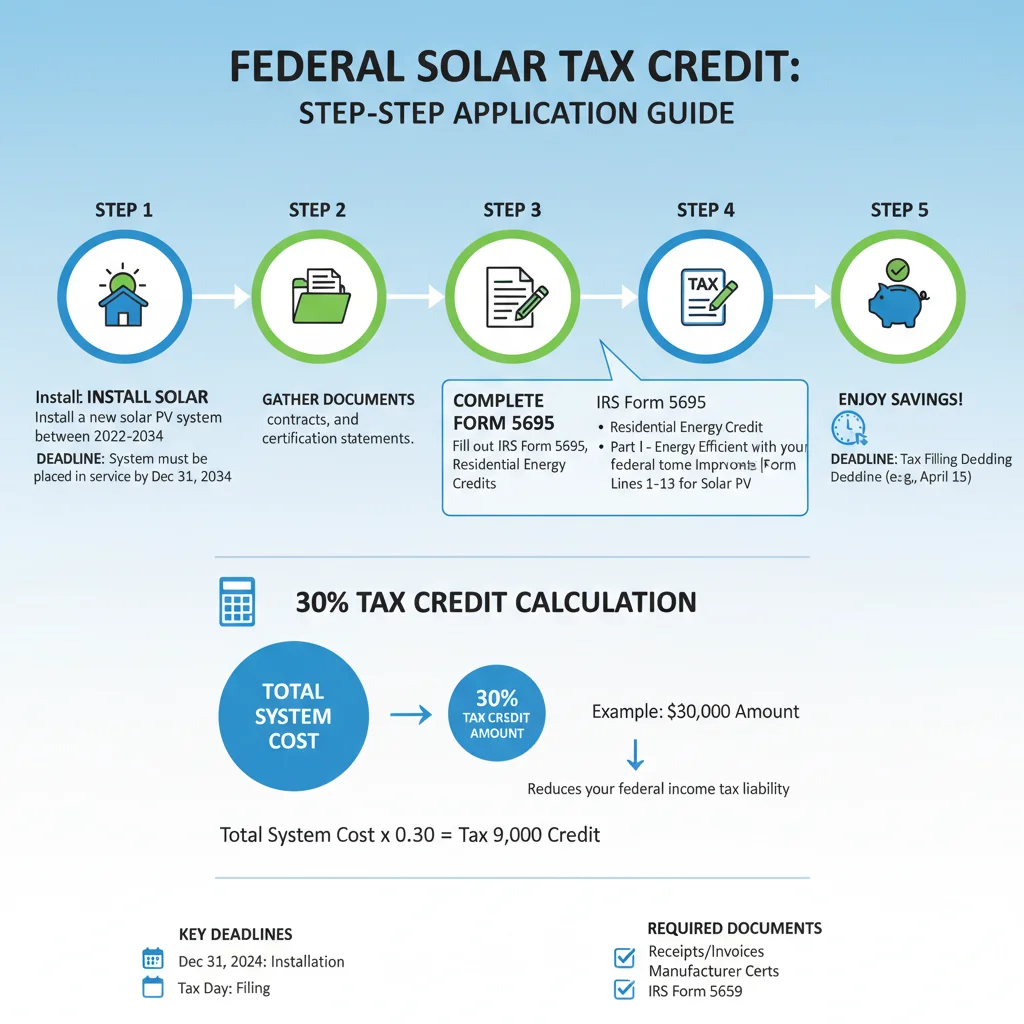
The 2026 federal solar tax credit is straightforward: it’s 30% of the total cost of your eligible solar energy system. The “total cost” includes all the components and installation expenses mentioned above. There is no cap on the amount of the credit for residential systems, meaning the more you invest in a qualifying system, the larger your potential tax credit will be.
Example Calculation:
Let’s say your total eligible expenses for a new solar PV system, including panels, inverter, mounting hardware, battery storage, and installation labor, come to $25,000.
- Total Eligible Costs: $25,000
- Tax Credit Percentage: 30%
- Your Federal Solar Tax Credit: $25,000 * 0.30 = $7,500
This means you would be eligible for a $7,500 reduction in your federal income tax liability for the year your system is placed in service. It’s crucial to understand that this is a *tax credit*, not a deduction. A tax deduction reduces your taxable income, while a tax credit directly reduces the amount of tax you owe, dollar for dollar. This makes credits significantly more valuable than deductions of the same amount.
What if Your Credit Exceeds Your Tax Liability?
The federal solar tax credit is non-refundable. This means if the credit amount is greater than the federal income tax you owe in a given year, you won’t receive the difference back as a refund. However, the good news is that you can carry forward any unused credit to future tax years. For example, if your credit is $7,500 but your tax liability for 2026 is only $5,000, you would use $5,000 of the credit in 2026 and have $2,500 remaining to apply to your 2027 tax liability. This carry-forward provision ensures that you can eventually utilize the full value of your credit, even if your tax liability is lower in the year of installation.
How to Claim the Federal Solar Tax Credit in 2026
Claiming the federal solar tax credit is a relatively straightforward process, but it requires careful record-keeping and proper tax form submission. Here’s a step-by-step guide:
Step 1: Purchase and Install Your Solar System
The first step is to have your eligible solar PV system purchased and installed. Ensure that the system is operational and “placed in service” within the 2026 calendar year. Keep all receipts, contracts, and documentation related to the purchase and installation, including detailed breakdowns of costs. This documentation is vital for verifying your expenses.
Step 2: Complete IRS Form 5695
When you file your federal income tax return for the year your system was placed in service (i.e., your 2026 tax return, typically filed in early 2027), you will need to complete IRS Form 5695, Residential Energy Credits. This form is used to calculate and claim various residential energy credits, including the federal solar tax credit.
On Form 5695, you will enter the total eligible costs of your solar PV system. The form then guides you through the calculation of your 30% credit. If you’ve installed other qualifying energy-efficient home improvements, you would include those on this form as well, though the solar credit calculation is separate and uncapped.
Step 3: Transfer the Credit to Your Form 1040
Once you’ve calculated the credit amount on Form 5695, you will then transfer this amount to your main tax form, Form 1040 (U.S. Individual Income Tax Return), specifically to Schedule 3, Line 5. This is where the credit directly reduces your overall tax liability.
Step 4: Keep Detailed Records
While you typically don’t submit your receipts with your tax return, the IRS may request them if your return is audited. It’s crucial to keep meticulous records of all expenses, including:
- Purchase agreements and invoices from your solar installer.
- Proof of payment.
- Documentation showing the system was placed in service (e.g., utility interconnection agreement, final inspection certificate).
- Any other relevant financial documents.
Consult a Tax Professional
While this guide provides a general overview, tax laws can be complex. It is always recommended to consult with a qualified tax professional or financial advisor, especially if you have a unique financial situation or complex tax needs. They can ensure you correctly claim the federal solar tax credit and advise on any other potential energy-related incentives you might be eligible for.
Combining the Federal Solar Tax Credit with Other Incentives
One of the most attractive aspects of the federal solar tax credit is its ability to be combined with other state and local solar incentives, further enhancing your overall savings. This stacking of incentives can significantly reduce the net cost of your solar installation, making it even more financially viable.
State and Local Rebates and Incentives:
- State Tax Credits: Similar to the federal credit, some states offer their own tax credits for solar installations.
- Rebates: Direct cash back programs offered by state energy offices or local utilities upon the installation of a solar system.
- Property Tax Exemptions: Some areas exempt the added value of a solar energy system from property tax assessments, meaning your property value increases without an increase in your property taxes.
- Sales Tax Exemptions: A few states offer sales tax exemptions on solar equipment, reducing your upfront costs.
It’s important to research what incentives are available in your specific area. Websites like the Database of State Incentives for Renewables & Efficiency (DSIRE) are excellent resources for finding comprehensive information on local programs.
Net Metering:
While not a direct upfront incentive like the federal solar tax credit, net metering is a crucial policy that significantly impacts the financial benefits of going solar. Net metering allows you to send excess electricity generated by your solar panels back to the grid, and you receive credits on your utility bill for this electricity. This effectively allows your electric meter to run backward, reducing your monthly electricity costs and sometimes even resulting in a credit on your bill. Most states have some form of net metering policy, though the specifics can vary.
How Combining Incentives Works:
When combining incentives, the general rule for the federal solar tax credit is that it is calculated on the *net cost* of your system after any rebates or grants. For example, if your $25,000 system receives a $2,000 state rebate, your eligible cost for the federal credit would be $23,000, resulting in a $6,900 federal tax credit ($23,000 * 0.30). However, if you receive a state tax credit, that does not reduce the basis for the federal credit, as it is also a tax credit rather than an upfront reduction in cost.
Always verify how different incentives interact with each other to ensure you maximize your overall financial benefit. A reputable solar installer can often help you navigate the various programs available in your region.
The Long-Term Benefits of Investing in Solar Beyond the Tax Credit
While the federal solar tax credit provides an immediate and substantial financial incentive, the benefits of installing a solar energy system extend far beyond the initial tax savings. Investing in solar is a long-term decision that offers numerous advantages, both financial and environmental.
Reduced Electricity Bills:
This is perhaps the most obvious and immediate benefit. Once your solar system is installed and operational, you will significantly reduce, or even eliminate, your monthly electricity bills. This provides predictable energy costs, shielding you from rising utility rates and saving you thousands of dollars over the lifespan of your system.
Increased Home Value:
Numerous studies have shown that homes equipped with solar panels sell for a premium and often sell faster than comparable non-solar homes. The added value of a solar system can often exceed its initial cost, especially when considering the federal solar tax credit and other incentives that reduce the net investment.
Environmental Impact:
By generating your own clean electricity, you significantly reduce your reliance on fossil fuels, thereby lowering your carbon footprint. This contributes to cleaner air, reduces greenhouse gas emissions, and helps combat climate change. For environmentally conscious homeowners, this is a powerful motivator.
Energy Independence and Security:
Having your own solar power system provides a degree of energy independence. You become less vulnerable to power outages and fluctuations in energy supply. With optional battery storage, you can even maintain power during grid blackouts, offering peace of mind and enhanced energy security.
Low Maintenance:
Modern solar panels are incredibly durable and require very little maintenance. Most systems come with long warranties (20-25 years), and routine cleaning is often the only upkeep needed, ensuring decades of reliable, free electricity generation.

Understanding the Future of the Federal Solar Tax Credit
The Inflation Reduction Act of 2022 not only reinstated the federal solar tax credit to 30% but also provided a clear roadmap for its future. This long-term certainty is a significant boon for homeowners considering solar installations in 2026 and beyond.
The Step-Down Schedule:
The 30% credit is locked in for systems placed in service from 2022 through 2032. After this period, the credit is scheduled to step down:
- 2033: The credit will decrease to 26% of the cost.
- 2034: The credit will further decrease to 22% of the cost.
- 2035 and Beyond: The residential credit is currently scheduled to expire.
This step-down schedule emphasizes the importance of acting sooner rather than later to maximize your savings. While a 22% or 26% credit is still substantial, the full 30% offers the greatest financial advantage. Planning your installation to be completed by the end of 2032 will ensure you receive the maximum available federal solar tax credit.
Potential for Future Changes:
While the current legislation provides a clear outlook, it’s always possible that future legislative action could modify these provisions. However, the consistent support for renewable energy over the past two decades suggests that incentives for solar are likely to remain a priority, even if their form evolves. Staying informed about energy policy changes is always a good practice.
Finding a Reputable Solar Installer
Choosing the right solar installer is as critical as understanding the federal solar tax credit itself. A reputable installer will not only provide a high-quality system but also guide you through the entire process, including understanding incentives and navigating permitting requirements.
Key Considerations When Choosing an Installer:
- Experience and Reputation: Look for installers with a proven track record, positive customer reviews, and relevant certifications.
- Licensing and Insurance: Ensure the installer is properly licensed and insured in your state.
- Product Quality: Inquire about the brands of panels, inverters, and batteries they use. Reputable installers work with high-quality, warrantied products.
- Warranty: Understand the warranties offered on equipment and workmanship.
- Financing Options: Discuss available financing, including solar loans, and how they interact with the federal solar tax credit.
- Customer Service: A good installer will offer excellent communication and support throughout the project and beyond.
- Local Knowledge: An installer familiar with local regulations, permitting processes, and utility interconnection rules can streamline the installation.
Obtain multiple quotes from different installers to compare prices, equipment, and services. Don’t be afraid to ask questions and seek clarification on any aspect of the proposal.
Conclusion: Harnessing the Power of the 2026 Federal Solar Tax Credit
The 2026 federal solar tax credit represents an unparalleled opportunity for homeowners to invest in clean, renewable energy while significantly reducing their financial outlay. With a generous 30% credit on the total cost of your solar installation, coupled with the potential to combine it with state and local incentives, the path to energy independence has never been more accessible or affordable.
Beyond the immediate tax savings, going solar offers a multitude of long-term benefits, including dramatically lower electricity bills, increased home value, a reduced environmental footprint, and enhanced energy security. The clear step-down schedule of the credit underscores the urgency to plan your solar project within the current 30% window, ensuring you maximize your return on investment.
By understanding the eligibility requirements, mastering the calculation, and diligently following the claiming process, you can confidently navigate the journey to solar ownership. Remember to consult with tax professionals and choose a reputable installer to ensure a smooth and successful transition. The sun is shining brightly on solar energy, and with the 2026 federal solar tax credit, now is an excellent time to harness its power for your home and your future.